Showing posts with label Weight-loss programmes. Show all posts

April 04, 2020

Steps To Get Fit at Home

The 5 Elements of Fitness

According to Steele, an effective fitness program has five components, all of which you can do at home:
  • A warmup.
  • A cardiovascular (aerobic) workout.
  • Resistance (strength-building) exercises.
  • Flexibility moves.
  • A cooldown
A warm-up could be an easy walk outside or on a treadmill, or a slow pace on a stationary bike. For the cardiovascular portion, walk or pedal faster, do step aerobics with a video, or jump rope -- whatever you enjoy that gets your heart rate up.
The resistance portion can be as simple as squats, push-ups and abdominal crunches. Or you could work with small dumbbells, a weight bar, bands or tubing.
Increase your flexibility with floor stretches or yoga poses. And your cooldown should be similar to the warm up, says Steele -- "cardiovascular work at a low level to bring the heart rate down to a resting state."
You can do strength work in same workout as your aerobic work, or split them up. Just be sure to warm up and cool down every time you exercise.
If you're short on time one day, increase the intensity of your workout, says Tony Swain, MS, fitness director of East Bank Club in Chicago. Instead of your usual 45-minute ride on the stationary bike, choose a harder program for 25 minutes and really push yourself. Choose the hilly walk in your neighborhood, or jog instead of walking.
You can step up the pace of your strength workout by doing compound exercises -- those that work more than one muscle group at a time.

Tips for home exercisers

The experts offer some other tips for home exercisers:
  • Challenge yourself and avoid boredom. At home, you won't have the variety of equipment and classes that are available at a gym. So surf the Internet and browse fitness magazines to check out new workouts and make sure you're exercising correctly. "Pictures are everything. Use them as a guide for form and technique," Swain says.
  • Find an exercise partner. You'll be less likely to find excuses when you've arranged to work out with a friend.
  • Schedule your workouts. "Have a plan," says Calabrese. "Look at a planner and write out your exercise appointments one month in advance. If something comes up and you have to change one, reschedule it immediately."
  • Use a journal to track your progress and jot down any breakthroughs you may have. When you have a bad day, write that down, too, to help you to find patterns you can break. For example, you may find an egg-white omelet gets you through your morning workout better than a bagel.
  • Set goals, like training for a race or losing 20 pounds. "A goals should be something you can't do right now, but you know is within your reach," Calabrese says. Give yourself mini-rewards along the way: a new fitness magazine, those workout tights you've been eyeing, or a new pair of sneakers.
  • Perhaps most important, make exercise as integral to your life as sleeping and eating, says Swain. "You have to think of it as a lifestyle change. It doesn't end. Get out of the mind frame that exercise is something you're only going to do for a period of time."

June 01, 2019

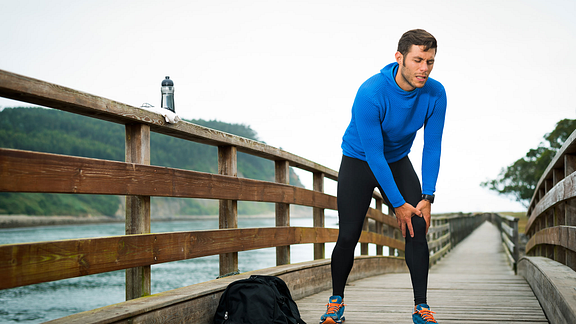
Is My Knee Pain Arthritis or a Torn Meniscus?

A torn knee meniscus often has similar symptoms to knee osteoarthritis, making it difficult to know the cause of the pain.
Common symptoms of both osteoarthritis and a torn meniscus include:
  • Pain around the knee joint, especially after activity, such as walking, running, or climbing stairs
  • Swelling, which occurs because of inflammation and may make the knee painful to the touch
  • Knee locking, which means it may be difficult to bend or fully extend the joint


A knee meniscus tear and knee osteoarthritis affect different types of cartilage in the knee:
  • Knee osteoarthritis refers to damage to articular cartilage. Articular cartilage is tough, slippery material that covers and protects the bottom of the thighbone (femur), the top of the tibia (shin bone), and back of the knee cap (patella).
  • A torn meniscus refers to damage to a rubbery, flexible piece of cartilage that provides cushioning between the thigh bone and shine bone in the knee.
Below you’ll find a few questions to ask yourself when determining the cause of knee pain, however, a visit to a health care professional is the best way to get an accurate diagnosis.

When did the pain start?

The biggest difference between arthritis and a torn meniscus is whether the pain developed over time or following an injury.
  • If your knee pain increases gradually and cannot be placed back to a specific injury you may have arthritis.
  • If your knee pain arose suddenly, you may have a meniscus tear. Athletes, especially those who play soccer, football, or basketball, are more likely to experience the type of injuries that cause meniscus tears.
It is possible for a meniscus to break down slowly, but this is less common.

What does the pain feel like?

Another difference between arthritis and a torn meniscus is how the pain feels.
  • People with osteoarthritis often report an intermittent, dull, or aching pain. The breakdown of cartilage may cause the bones to grind against each other when moving, which can cause a feeling of stiffness or produce a crunching sound.
  • People with a torn meniscus often complain of sharp, immediate pain following an injury. The pain may go away with rest and return again with movement, especially the same type that caused the injury. Tenderness to the inside or outside of the knee may indicate a meniscus tear.
Exactly how the pain feels will be determined by the severity and location of the arthritis damage or meniscus tear.

Have you tried the Thessaly test?

A meniscus tear can be tested for by using a diagnostic exam called the Thessaly test. You can do this yourself while resting your hands on a counter or another person for support.
  1. Stand on the leg to be tested with your knee bent slightly (about 20 degrees). Bend your opposite knee behind you, so that your foot is off the floor.
  2. Keeping your foot planted, twist your body so your hips rotate back and forth 3 times.

If you experience a catching or locking feeling during the test, you may have a torn meniscus.

How old are you?

Age is not just a number when it comes to determining the cause of knee pain. Arthritis is a degenerative disease, meaning it is more likely to occur in older adults.
A torn meniscus is a cartilage injury that can happen at any age, although more likely to occur in the younger, active, population.

Getting a diagnosis and treatment for knee pain

Whether you think you have knee arthritis or a torn meniscus, your best bet is to visit a health care professional for an accurate diagnosis and treatment. Early treatment can prevent your symptoms from worsening and, in some cases, help you avoid future surgeries.

February 11, 2013

How Much Fats Do You Need For Better Health and Fat Loss?

 http://t0.gstatic.com/images?q=tbn:ANd9GcQ0jXLiBgSTw5ZjZwzVhb3oaynaIihQMqn_c0xH1tQ-gDIefpjz

 How Much Fats Do You Need For Better Health and Fat Loss?
  • Add 2 teaspoons of olive oil per meal in your vegetables or to your meat when you cook it.


  • Do not add oil to a meal if you are eating a fatty fish like salmon which is rich in good fats.


  • If you do not like olive oil or oily fish, eat your grilled meats and your natural vegetables but do not forget to add another source of good fats. What you can do in this case is to consume 15-20 grams of almonds or walnuts twice a day with any meal.
I recommend that you try as hard as possible to get your good fats from these natural sources. If you have issues consuming your good fats from food, I recommend an Essential Fatty Acids supplement like Labrada's EFA Lean which contains a variety of good fats. I suggest a dose of 3 capsules in 2 of your fat free meals.

Now that we have covered the myth that in order to lose fat you need to stop eating fats, let's talk about the sort of food that you can eat in order to promote fat loss.


Foods That Promote Fat Loss

When we start a diet, the first thing to do is to make the right food choices. I will eliminate all of the confusion on what to eat by detailing exactly what foods help to promote fat loss:

  1. Choose the right carbohydrates like whole grain pasta, brown rice, oatmeal, potatoes, peas, corn (and yes, these are vegetables but in the category of starchy carbohydrates). Forget processed carbohydrates that come from candy, cakes, processed breads, cereals and breading as these will get you fat.


  2. Choosing the right proteins like chicken (knowing that the chicken breast is much less fatty than other parts such as the thigh or the wings), white fish and salmon (yes, salmon is a fatty fish but the fats are GOOD fats loaded with Omega 3s), 90% lean steaks, egg whites (with 1-2 egg yolks as these also contain good fats), and turkey. Avoid pork (because it is high in saturated fats) and reconstituted meats such as chicken nuggets, Cordon Bleu, deli meats and fast foods that contain lots of fat.


  3. Don't forget to eat your vegetables. The best vegetables you can eat are: green beans, broccoli, cauliflower, mushrooms, spinach, asparagus, lettuce, tomatoes, peppers, cucumbers, garlic, and onions. You can have a desert, but it has to be a healthy one.


  4. Concentrate on low calorie desserts like Sugar Free Jello and you can also have a piece of fruit with it. Samples of good fruits are: apple, kiwi, peach, strawberry, pear, pineapple, watermelon. All these fruits are good for health but like all fruits, they contain fructose. Thus, for the best fat loss, do not eat more than 2 of these fruits per day when on a fat loss diet. Note: Take a look at Hugo's article on Why Fruits Need to be Limited During a Fat Loss Diet?


  5. For good fats, concentrate on getting them from the following sources: extra virgin olive oil, almonds, walnuts, hazelnuts. Eliminate butter, cheese and other sauces that come already prepared as they usually contain added sugars and the wrong kind of fats!
Putting It All Together and Creating Your Balanced Diet

With all these food choices, it is now easy to compose a balanced meal without bad fats. What is a balanced bodybuilding diet you may ask? One that consists of 5-6 small meals a day consisting of 40% carbs, 40% proteins and 20% fats as laid out in Hugo's Characteristics of a Good Nutrition Program.

A normal man needs 2000 to 2500 calories a day. Thus, at 40% Carbs/40% Proteins/20% Fats he will need around 200-250 grams of carbs, 200-250 grams of protein and 45-55 grams of good fats per day divided over 5-6 meals. (Note: 1 gram of carbs = 4 calories, 1 gram of protein = 4 calories and 1 gram of fat = 9 calories).

A normal woman with average activity who is weight training and looking for fat loss needs 1200 to 1500 calories per day. That comes out to 120-150 grams of carbs, 120-150 grams of protein and 26-33 grams of good fats per day divided over 5-6 meals.

Conclusion

There you have it! Now you have a very good base to design your diet and get started on your way to fat loss. The power is within you!

About the Author

Cecile Bayeul was born in France in 1982 in a firefighter family. She wanted to become a firefighter and passed the tough professional firefighter tests which included various physically demanding feats. However, she decided to keep a more peaceful job (as her family wanted her to) so she became a nurse.

As a registered nurse she ended up studying various diet protocols for patients with special nutritional requirements due to their sicknesses.

In order to relieve stress from her job and to heal from an anorexia caused by a difficult divorce she picked up natural bodybuilding. Through bodybuilding she learned to regain her confidence and to be happy with her body.

Her passion for fitness led her to start conducting personal training not only for women but for men as well. She teaches that by embarking into a fitness program you can achieve any body that you want; something that builds up faith in oneself and develops the valuable skill of goal setting; things that at the end of the day improve every single aspect of your life!

February 04, 2013

Bodybuilding Arms Workout: Build Your Arms for the Summer With This Arms Workout


http://t1.gstatic.com/images?q=tbn:ANd9GcTL2SHy5qTVas7zFhQ7GGheU-ipWGJWrEiKhB0g0VCOEo1caSMoqw

When people think of bodybuilding, the first thing that comes to mind is big arms. How many bodybuilders, me included, just started by doing some biceps curls? After all, one of the most common requests bodybuilders get is to flex their arms. And while a great physique is much more than big arms, nobody can argue that all great physiques have equally great arms!

Since I have gotten a lot of requests lately to publish a new arm routine to get the arms ready for summer, I decided to publish one of the latest bodybuilding routines that I have been using to train my arms.

In order to use this routine you will need to incorporate it into a split routine that works both biceps and triceps on the same day. This routine is for intermediate to advanced trainees. If you are an absolute beginner, please refer to the bodybuilding routine presented on my getting started in bodybuilding guide.
http://vitalbynature.net/wp-content/uploads/2012/06/bodybuilding-myths-2.jpg
Gain Up To An Inch In Your Arms With This Bodybuilding Arms Workout

Without much further ado, here is your bodybuilding workout for great arms over the summer. You will be using trisets and supersets. A triset is composed of three exercises that get performed one after the other with no rest in between. Only after you perform the last exercise on the triset you can rest for the recommended amount of time and start over.

A superset is the same as a triset, except that it is composed of only two exercises.

For more advanced techniques like these ones, please take a look at my article on Advanced Bodybuilding Training Techniques To Break Plateaus.

As you will see, I am offering you three workouts below. I want you to rotate these workouts. So one day you will do Workout (A), another day Workout (B) and another day Workout (C).

Workout (A)

Triset:
Triceps Pushdowns 3-4 sets of 10-12 reps
Concentration Curls 3-4 sets of 8-12 reps
Overhead Triceps Extensions 3-4 sets of 10-12 reps
(Rest 1 minute between trisets)

Triset:
Incline Dumbbell Curls 3-4 sets of 6-8 reps
Lying Dumbbell Triceps Extensions 3-4 sets of 8-10 reps
Hammer Curls 3-4 sets of 8-12 reps
(Rest 1 minute between trisets)

Superset:
Wrist Curls 2 sets of 25-50 reps
Reverse Wrist Curls 2 sets of 25-50 reps
(Rest 30 seconds between superset)

Workout (B)

Triset:
Triceps Kickbacks 3-4 sets of 15-20 reps
Barbell Curls 3-4 sets of 8-12 reps
Triceps Pushdowns with Straight Bar 3-4 sets of 10-12 reps
(Rest 1 minute between trisets)

Triset:
Concentration Curls 3-4 sets of 6-8 reps
Triceps Dips on Bench 3-4 sets of 15-20 reps reps
Reverse Barbell Curls 3-4 sets of 8-12 reps
(Rest 1 minute between trisets)

Superset:
Reverse Wrist Curls 2 sets of 25-50 reps
One Arm Dumbbell Wrist Curls 2 sets of 25-50 reps
(Rest 30 seconds between superset)

Workout (C)

Superset:
Preacher Curls 10 sets of 10 reps
Parallel Bar Dips 10 sets of 10 reps
(Rest 1 minute between supersets)

Triset:
Cable Curls 3 sets of 15-20 reps
Rope Triceps Pushdowns 3 sets of 15-20 reps reps
Barbell Wrist Curls 3 sets of 25-50 reps
(Rest 1 minute between trisets)

Bonus Abdominals' Routine

As a bonus, here is a nice abs routine that you can do before the arms workout:

Triset:
Leg Raises 3 sets to failure
Bicycle Crunches 3 sets to failure
Crunches 3 sets to failure


This abdominals' routine took me less than 15 minutes to perform and it proved to be not only a great abdominal workout but also an awesome way to warm-up the body and get it ready for some arm work.

Conclusion

Try out the arms routine above and let me know how it worked out for you. You'll probably have as much fun as I did and will get a great pump as well. The whole thing, counting abs, should take you around 50 minutes, give or take 10.

http://www.elitefitness.com/images/ben-pakulski/IFBB-pro-bodybuilder-ben-pakulski.jpg

September 14, 2012

Stopping the weight-gain: Menopause


http://www.healthyfood.co.nz/sites/default/files/styles/190xvariable/public/articleimages/1184.jpg


Menopause is well known as being a time when weight is gained. Eating well and being active are key.
Menopause causes the greatest revolution in hormone levels. Blamed for many things during a woman's life, her hormones are now also maligned for causing weight gain. As well as the
effect of age, falling levels of the female hormones oestrogen and progesterone further reduce the rate at which energy is used – known as metabolic rate. This is reflected in the dietary
recommendations for women over the age of 50. The amount of kilojoules recommended each day is less, but the amounts of vitamins, minerals and protein remain roughly the same.
So eating healthily, without some of the 'extras', is vitally important to stay fit and well. Remaining active will also help keep weight stable. Although many women feel lethargic and low during this time of change, activity boosts metabolic rate, as well as feelings of self-esteem and self-worth.

Tummy trimming tips for menopause

  • A brisk walk each day is one of the best ways to help yourself feel better, and can be enjoyed with friends too.
  • Don't skip breakfast. Missing meals does not help weight control and can leave you feeling even more tired and lethargic.
  • Take a tip from the Japanese, the masters of portion control. Keeping the amount we eat at each meal in check is important for controlling weight, and there is some evidence it can help us live longer too.
  • If grandparenthood finds its way to you, allow your grandchildren to run you off your feet – it's good for you, if exhausting!
  • Enjoy this time of life to the maximum, but indulge yourself in non-food treats. Sadly, you will start to lose friends to some of our common lifestyle illnesses, such as heart disease and cancer. Although these usually take years to develop, it's never too late to help yourself by eating well.

September 07, 2012

Quick and Easy Ways to Start

Quick and Easy Ways to Start
Get started on a healthier lifestyle with these ideas!
No time for breakfast?
  • Grab an apple, an orange or any other fruit as you head out the door.
  • Pack baby carrots, nuts, or dried fruit for a snack.
  • Take whole wheat crackers, lean meats and low-fat milk along with you.
  • Try taking leftovers and eating on the way.
  • Munch on veggies, pretzels, or popcorn.
Mom with children at the grocery store
At a fast food restaurant?
  • Try a grilled chicken sandwich and a side salad.
  • Split an order of fries.
  • Leave off the mayonnaise, sauce and spreads when ordering a sandwich.
  • Share a rich dessert with a friend.
Want to cut fat in meals?
  • Use a cooking spray instead of oil to sauté foods.
  • Trim visible fat from meat and remove skin from poultry, too.
  • Instead of cheese and heavy salad dressings, add fiber-rich beans and peas to your salad meals. Canned chick peas or other beans are a delicious addition to a salad.
Woman making dinner
Need to get moving?
  • Work off a big lunch by taking a bike ride or a walk with your kids after work.
  • Instead of socializing with friends by watching videos or dining, plan to go walking, biking or dancing.
  • Aim for the farthest parking spot, not the closest, so you can get in extra walking.
  • Walk the sidelines or stroll around the field instead of lounging in the stands while the kids play soccer or softball.
  • Run up and down the stairs with each load of laundry, get up and change the channel, and walk to your co-worker’s office instead of calling.
  • Join a step aerobics, kick-boxing or body toning class. Check your local park district, recreation center, or health club to find the best option for your budget and skill level.
Family gardening

Weight-loss tips for men: How do I know what size is right?

Weight-loss tips for men: How do I know what size is right?

http://www.healthyfood.co.nz/sites/default/files/styles/190xvariable/public/articleimages/640.jpg

A few days ago, I struggled out of a deep sleep and began preparing for my morning stumble to the local coffee cart (it's a habit, I confess). I pulled a pair of pants out of the drawer, and sleepily yanked them up, but lo and behold! The button was a little tight. Had they just come out of the drier? Probably not. This discovery kick-started me into a mini reconstruction of my food plans because I know the fit of my trousers is a good measure of changes in my body size, whereas the scales can be confusing.
Most men I talk to are not satisfied with the methods of body size determination available. BMI (Body Mass Index) can be confusing. So I want to give you two tips for measuring your body size which may be more realistic for your situation.
Reality is in your pants: We all have a few pieces of clothing which 'fit' in a particular way – you probably recognise the feeling of them better than anything else. I have a pair of crappy old ex-British Army pants (op shop – $4). I love them to bits and I know how they fit and it was these pants I yanked on and it was like a loudspeaker blasting in my ear. Take a moment and identify your version of my pants. Once a week, when they are clean and dry, first thing in the morning pull them on and relax… then ask yourself, "Do these pants feel normal?" Do the same with a jacket or shirt. Fabric doesn't lie.
Waist to height ratio is another way to size yourself up. Do these measurements once a week and keep track of the results. Compare the results each week to gage real measured changes to your body.

Waist to height ratio

To calculate your waist to height ratio, measure your waist (around your belly button) and your height, then divide the waist measurement by the height measurement.
The ratio for men and women is ideally less than 0.5  –  which means your waist should be no more than half your height. My waist, for example, is about 89cm and my height is 183cm, which makes my ratio 0.486.
If you're on a weight-loss or exercise programme, you'll see changes in your waist measurement and the ratio.